
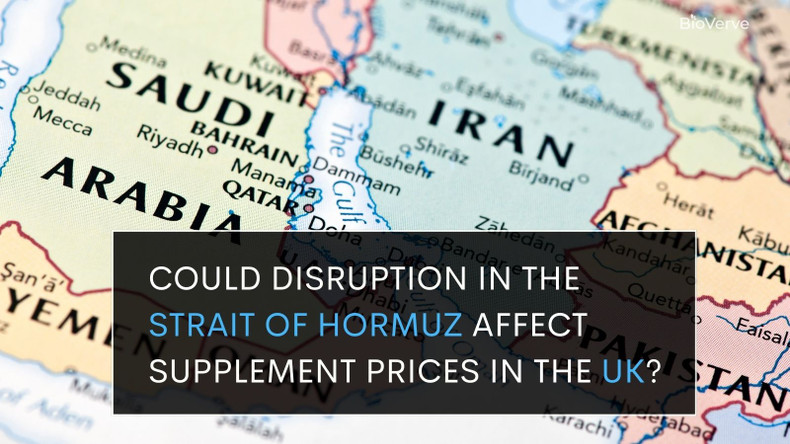
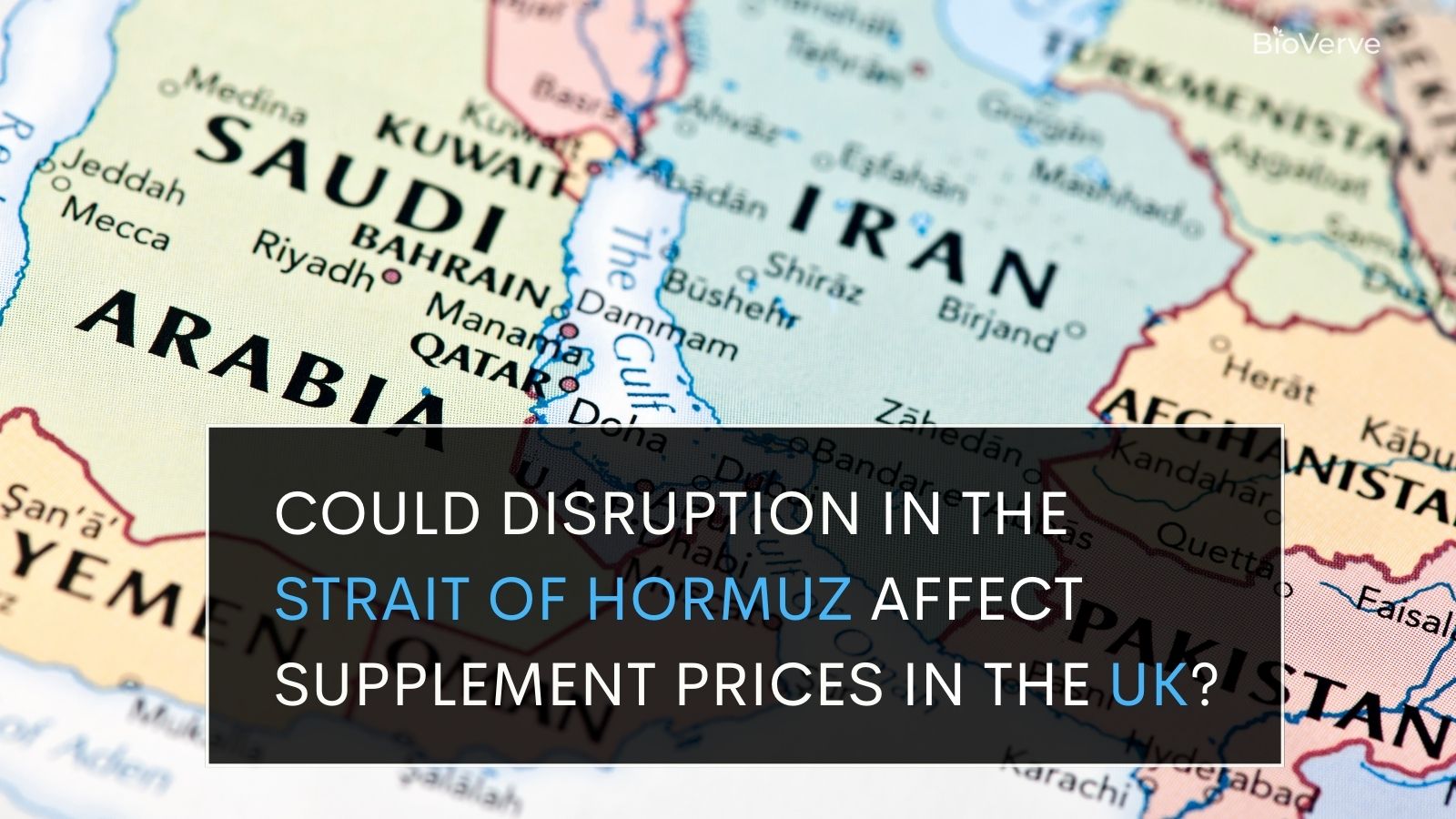
How Could Disruption in the Strait of Hormuz Affect Supplement Prices in the UK?
A swimmable bottleneck that can ripple into energy, freight, packaging & ingredient costs
Imagine one of the world’s most important trade routes being only about 21 miles (34 km) wide - roughly the same distance as crossing the English Channel between Dover and Calais.
That is the reality of the Strait of Hormuz, a narrow stretch of water connecting the Persian Gulf to the Arabian Sea. Despite its modest width, this corridor handles around a quarter of the world’s seaborne oil trade and roughly 20% of global liquefied natural gas (LNG) shipments.
For readers in the United Kingdom, the Strait sits approximately 3,000-3,500 miles away (4,500-5,500 km). It would be easy to assume events there have little relevance to everyday products here at home.
Yet in an interconnected global economy, disruption in a key chokepoint can ripple across energy markets, shipping routes, manufacturing inputs, and eventually consumer goods - including plant extracts, fruit extracts, and isolated nutrients used in supplements.
Putting this into perspective: recent disruptions that affected UK supplement pricing
Over the past six years, several global events have already affected ingredient availability and costs for UK supplement brands:
- 2020 - UK COVID lockdowns: manufacturing slowdowns, port congestion, and container shortages disrupted supply.
- 2022 - Russia-Ukraine war: European energy costs surged, lifting manufacturing, fertiliser, packaging, and freight costs.
- 2025 - US global tariff increases: new trade measures increased uncertainty across commodity and logistics markets.
If disruption affecting the Strait of Hormuz were to persist beyond the short term, it raises a fair question:
Could this become another event added to that list - another global disruption remembered for putting upward pressure on supplement supply chains and prices?
The Strait of Hormuz: why it matters for global trade
The Strait of Hormuz is one of the most strategically important shipping routes in the world. Around:
- 25% of global seaborne oil
- ~20% of global LNG
passes through this corridor each year.
Its significance comes from the fact that so much global energy trade passes through a remarkably narrow bottleneck. At its tightest point, the Strait is around 21 miles (34 km) wide - comparable to the English Channel at the Dover Strait.
To put that into perspective, endurance swimmers have crossed comparable distances (such as the Channel), sometimes taking around 15 hours. In other words: a substantial portion of global energy trade moves through a passage that is, in practical terms, swimmable.
When disruption occurs in such a chokepoint, energy prices can react quickly. And because energy is a foundational input for manufacturing and logistics, the knock-on effects can reach far beyond the region - including UK-based supplement supply chains.
Energy costs and supplement manufacturing
Many supplement ingredients require energy-intensive processing before they ever reach a capsule or powder. Examples include:
- solvent extraction of plant compounds
- spray drying or freeze drying of fruit powders
- fermentation of amino acids and vitamins
- purification and concentration of active nutrients
Higher oil or natural gas prices can raise costs for industrial heating, steam generation, solvent recovery, drying processes, and electricity at production facilities.
Energy is rarely the single biggest cost in supplement manufacturing, but sharp increases can still influence total production cost - especially for complex, standardised extracts and high-purity nutrients.
Freight and shipping costs for bulk ingredients
Most nutraceutical raw materials travel long distances before reaching UK encapsulation or packaging facilities. If shipping lanes become riskier or vessels must reroute, several cost pressures can emerge:
- higher marine insurance premiums
- longer routes and higher fuel consumption
- reduced vessel availability and container tightness
- slower lead times
Even relatively modest freight changes can affect the cost of bulk ingredients, particularly where margins are tight and volumes are high.
Packaging costs: plastics and glass
Supplement packaging is closely linked to energy markets:
Plastic containers
Most supplement bottles and many pouches are made from petrochemical plastics such as PET, HDPE, or polypropylene. Rising oil prices can lift the cost of these packaging materials.
Glass bottles
Glass production is extremely energy intensive. Furnaces operate at temperatures exceeding 1,500°C, so higher natural gas prices can also raise glass packaging costs.
Agricultural inputs for botanical ingredients
Many supplement ingredients begin as agricultural crops (for example turmeric, ginger, ashwagandha, berries, and citrus). Crop yields depend heavily on fertilisers, which in turn are influenced by energy and industrial chemical inputs.
The Middle East is a major producer of sulphur, an important component used in fertiliser production. Disruptions affecting refinery output or energy costs can therefore influence agricultural costs globally, which can filter through to botanical ingredient pricing over time.
Which supplements could experience price pressure first?
Not all supplements respond to global supply disruption in the same way. Ingredients that depend on international crops, specialised extraction, or long-distance shipping tend to be more sensitive to energy and freight costs.
Botanical extracts from South & Southeast Asia
Several adaptogenic and herbal extracts originate primarily from India, Malaysia, and Indonesia. Examples include:
- Bacopa Monnieri Extract (30% Bacosides)
- Ashwagandha Extract (15% Withanolides / 6% Withaferin A)
- Fadogia Agrestis Powder
- Fadogia Agrestis Extract (10:1 Extract Ratio)
- Tongkat Ali Extract (2% Eurycomanone)
- Kacip Fatimah
These ingredients often require harvesting, drying, solvent extraction, and standardisation - each step relying on energy inputs, laboratory infrastructure, and international freight.
Standardised functional plant extracts
Standardised extracts require additional purification and analytical testing. Examples include:
- Turmeric Extract (95% Curcuminoids)
- Ginger Extract (6% Gingerol)
- Oleuropein Extract (40% Oleuropein)
- Schisandra Extract (2% Schisandrins)
- Fenugreek Seed Extract (Furosap®)
- Irvingia Gabonensis Extract (Furoslim®)
- Green Bean Coffee Extract (GCB-70)
Because standardisation adds processing steps, these extracts can be more sensitive to energy and freight costs than simple raw powders.
Fruit extract concentrates
Fruit-derived extracts depend on seasonal harvests and concentration processes such as spray drying. Examples include:
- Blueberry Extract (20:1)
- Strawberry Extract (20:1)
Large volumes of raw fruit are required to produce concentrated extracts, which makes agricultural inputs and drying costs particularly relevant.
Fermentation-derived nutrients and advanced compounds
Some ingredients rely on energy-intensive fermentation and purification environments. Examples include:
- NMN (98% Purity)
- Resveratrol (98% Purity)
- Liposomal Vitamin C (Original 50%)
Medicinal mushrooms
Mushroom extracts can also be sensitive to cultivation and processing costs. Example:
- Lion’s Mane Extract (10% Polysaccharides)
A note on supply chains
Global supply chains are resilient. When disruption occurs, producers often adjust routes, increase buffer stock, or expand capacity in other regions. Price pressure can happen, but markets frequently adapt over time.
For companies focused on high-specification nutraceutical ingredients, careful sourcing and long-term supplier relationships become especially important when global supply chains face uncertainty.
BioVerve’s perspective
At BioVerve, our goal is always to maintain stable pricing wherever possible.
At the time of writing, we have no plans to increase prices across our supplement range.
However, the supplement industry operates within global supply chains, and factors such as energy prices, freight costs, packaging materials, and agricultural inputs inevitably influence the broader market.
The encouraging reality is that global trade is fundamentally built on cooperation. Farmers, scientists, manufacturers, shipping companies, and retailers across many countries work together every day to bring products to market.
In many ways, trade itself reflects a shared desire among nations to cooperate and exchange goods peacefully. Our hope is that stability returns quickly and that these supply chains continue functioning smoothly - benefiting producers, manufacturers, and consumers alike.
Questions? You can reach me at mo@bioverve.co.uk.